


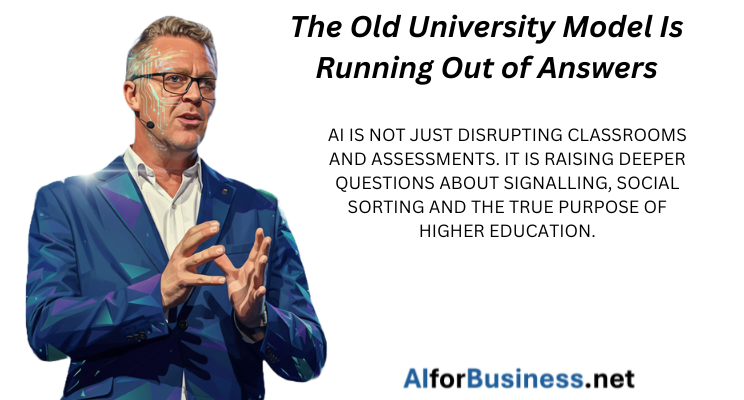
The Old University Model Is Running Out of Answers

AI is not just disrupting classrooms and assessments. It is raising deeper questions about signalling, social sorting and the true purpose of higher education.
Follow me on LinkedIn: https://www.linkedin.com/in/johanosteyn/
A provocative YouTube video asking whether Harvard is a “scam” might sound like an attack on one famous university, but it is really a challenge to a much older system. The video lands at a moment when artificial intelligence is changing how people learn, how employers judge talent, and how families think about educational success. For decades, elite universities have sold more than teaching. They have sold status, access, legitimacy and the promise of a better life.
That promise still matters, especially in countries like South Africa, where education carries deep hopes of mobility and dignity. But the old model is under new pressure. When knowledge is abundant, tools are intelligent and practical capability is easier to prove in public, universities can no longer assume that prestige alone will settle the question of value.
CONTEXT AND BACKGROUND
For a long time, universities benefited from scarcity. Knowledge was harder to access, credentials carried enormous weight, and employers often used degrees as a rough proxy for intelligence, discipline and future promise. Elite institutions became symbols of merit, even when access to them was never as fair or neutral as the public story suggested. TIME’s recent global university ranking underlined both the continuing power of top institutions and the stubborn reality that wealth still shapes who gets through those gates.
That matters because higher education is not just an academic issue. It is a social and economic one. In South Africa, the stakes are especially high. Reuters reported in February that the official unemployment rate had fallen to 31.4%, but the country still has one of the highest jobless rates in the world, with young people facing particularly grim prospects. In that context, a degree is often seen not simply as a qualification, but as an escape route.
The problem is that the labour market is changing faster than the university system. The Financial Times recently described a “graduate job drought”, noting that entry-level roles are shrinking in a market shaped by automation, AI and employer caution. The old script, study hard, get the right degree, secure the right job, is no longer as reliable as it once seemed.
INSIGHT AND ANALYSIS
Artificial intelligence is accelerating this reckoning because it weakens one of higher education’s oldest assumptions: that polished academic work proves deep understanding. AP reported this week that more colleges are turning to oral exams and live defences because written assignments can now be heavily shaped by AI tools. That is not a small adjustment. It is a sign that institutions are being forced to rethink what real learning looks like.
There is also a deeper problem. Many universities have long acted as signalling systems. The degree itself mattered, but so did the brand attached to it. Employers were often hiring the label as much as the learning. Forbes reported in January that while employers still value college degrees, they are placing growing weight on certificates and demonstrable readiness for work. In an AI-rich economy, that shift makes sense. If intelligent tools can help people research, code, draft, design and test ideas more cheaply and quickly, then the real differentiator becomes judgment, adaptability, communication and proof of ability.
This is where the myth of meritocracy begins to wobble. Elite education has often presented itself as a neutral ladder for the brightest and most deserving. In reality, it has also rewarded polish, access, inherited confidence and cultural fluency. AI does not erase those inequalities, but it does expose them. It becomes harder to treat pedigree and competence as the same thing when more people can build public portfolios, launch projects and demonstrate real skill outside traditional systems.
IMPLICATIONS
Universities still matter, but they need better answers. Their value can no longer rest mainly on scarcity, selectivity and history. If they want to remain credible, they will need to focus far more on mentorship, ethical reasoning, intellectual challenge, interdisciplinary thinking and the cultivation of sound judgement.
For South Africa and the rest of Africa, this matters enormously. We should be careful not to import global prestige myths without asking whether they actually serve our realities. Our education systems need to prepare young people for a world of uncertainty, technological acceleration and changing work, not simply for an old prestige hierarchy.
CLOSING TAKEAWAY
The question is not whether universities still have a role. Of course they do. The question is whether they are willing to justify that role in a different world. In the AI era, prestige is no longer enough and polished outputs are no longer convincing on their own. Institutions that continue to trade mainly on status may remain famous while becoming less persuasive. But those that help people think clearly, act ethically and prove what they can actually do will still matter deeply. For our children, that distinction is everything. The future should belong not just to those who enter elite systems, but to those who can learn, adapt and contribute meaningfully.
Author Bio: Johan Steyn is a prominent AI thought leader, speaker, and author with a deep understanding of artificial intelligence’s impact on business and society. He is passionate about ethical AI development and its role in shaping a better future. Find out more about Johan’s work at https://www.aiforbusiness.net


Comments