


High School Graduates Are Getting Jobs Faster Than University Graduates — and AI Is Part of the Reason
- Johan Steyn

- Jun 2
- 6 min read
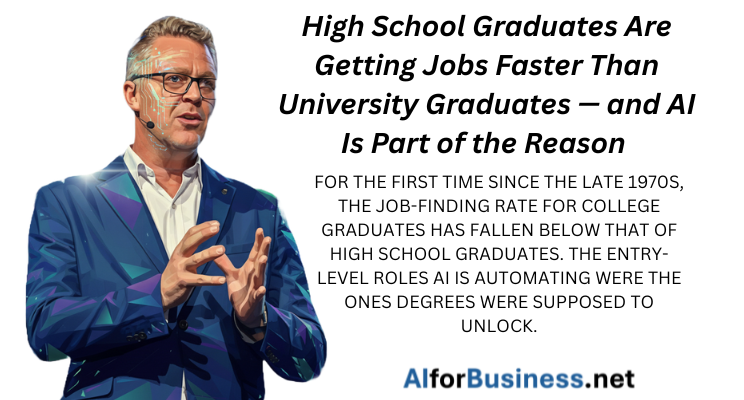
For the first time since the late 1970s, the job-finding rate for college graduates has fallen below that of high school graduates. The entry-level roles AI is automating were the ones degrees were supposed to unlock.
Sign up for my Substack daily AI newsletter here.
See my AI Training course portfolio for corporate Business Leaders here.
Follow me on LinkedIn: https://www.linkedin.com/in/johanosteyn/
Something unusual is happening in the global graduate labour market, and the data is now precise enough that it can no longer be attributed to a pandemic anomaly or a business cycle. For the first time since the late 1970s, young people with only a high school diploma are finding employment faster than those who went on to earn a university degree. This is not a rumour circulating in career advice columns. It is a documented, quantified finding from the Federal Reserve Bank of Cleveland, published in November 2025 by researchers Alexander Cline and Barış Kaymak, based on five decades of monthly employment data. The unemployment gap between high school and college graduates, which oscillated around five percentage points for decades, has narrowed to just 2.5 percentage points — its lowest level since records began.
The finding that deserves the closest attention is not the gap itself but what is driving it. High school graduates are not doing dramatically better. The college job-finding rate — the percentage of unemployed graduates who successfully secure employment each month — has been declining steadily since around the year 2000, and has now fallen to roughly match the rate for high school graduates. In the most recent period measured, 41.5% of unemployed young high school graduates found work each month, compared with 37.1% of young university graduates. A long period of relatively easier job-finding prospects for degree holders has ended, and the Cleveland Fed researchers are unambiguous about that conclusion.
CONTEXT AND BACKGROUND
The structural forces behind this shift have been accumulating for longer than the current anxiety about AI suggests. The Cleveland Fed paper identifies a switch, beginning around 2000, from college-biased to education-neutral growth in labour demand — a long-term structural trend the researchers attribute to changing patterns in technology and labour demand rather than to AI specifically. What AI introduces now is a powerful forward-looking accelerant onto an already vulnerable graduate market: the entry-level white-collar roles that university degrees were designed to unlock are precisely the functions that generative AI is most directly threatening.
Sectors experiencing the highest job creation in the post-pandemic economy, healthcare support, logistics, skilled trades, hospitality, and infrastructure, do not require four-year degrees. They require physical presence, specific certifications, and practical competency. High school graduates can enter them directly, without the delay of a degree programme or the mismatch of a qualification that was designed for a different kind of economy.
According to Gallup's 2025 workforce study, the percentage of employees who report using AI in their role at least a few times a year has nearly doubled in two years, rising from 21 per cent to 40 per cent, with adoption concentrated heavily in white-collar knowledge roles — precisely the ones that graduate entry-level positions have historically supported. The cognitive starter role, the position that used to absorb a new graduate while they built professional capability, is contracting at exactly the moment when the largest cohorts of graduates in history are competing for it.
INSIGHT AND ANALYSIS
The Cleveland Fed paper is careful to distinguish between what has changed and what has not. College graduates continue to experience lower job separation rates once employed, meaning greater job security over the course of a career. They retain a substantial wage premium, with Federal Reserve Bank of New York data confirming that the median earnings advantage for bachelor’s degree holders hovers around 24,000 US dollars annually over high school graduates, producing a lifetime earnings premium exceeding one million dollars. The convergence the paper documents concerns the initial step of securing employment, not overall labour market outcomes. But that initial step is not a minor inconvenience. Poor job market outcomes early in a career produce persistent earnings shortfalls that compound over decades. The first job is not simply the first job. It is the foundation on which everything that follows is built.
I have previously written about the double trap facing this generation: AI used to bypass the cognitive development that education was supposed to provide, meeting a labour market where AI has already taken the entry-level roles where that development would have been completed on the job. The Cleveland Fed data puts precise numbers on one half of that trap. The job-finding rate for young graduates has not merely softened. It has declined to match the rate for workers who never attended university, in a labour market where the cognitive starter roles that justified the degree are being automated away.
The supply side of the problem compounds the demand side. The volume of degree holders entering the labour market has grown steadily for two decades, adding ever-larger cohorts of graduates to the ranks of job seekers even as the technology landscape shifted away from college-biased labour demand. More graduates competing for fewer cognitive entry-level roles, in a market where AI is now capable of performing the baseline functions of those roles, is not a temporary pressure. It is a structural condition.
IMPLICATIONS
For employers, the implications are both immediate and strategic. Organisations that continue to recruit graduates on the basis of degree credentials without examining what those credentials currently certify are building talent pipelines on assumptions that the labour market data no longer supports. The graduate with a finance degree who cannot do what the AI cannot do — interpret ambiguity, exercise judgment under uncertainty, advise a client in a way that carries professional accountability — is not a financial analysis resource. They are a training liability. The organisations that will build durable talent pipelines over the next decade are those that define clearly what human capability they are hiring for, and assess candidates on that basis rather than on the credential alone.
For higher education institutions, the data is a direct challenge to curriculum design. The entry-level roles that degree programmes have implicitly pointed toward for decades are the ones contracting fastest. The question is not which degrees to eliminate but which capabilities within those degrees to rebuild, at a pace that reflects the speed at which the labour market is moving. Curriculum review cycles of five to seven years are being outpaced by labour market shifts measured in months. Universities that do not close that gap will continue producing graduates whose qualifications certify tasks that AI has already assumed.
For boards and executives overseeing workforce strategy, the broader argument is one of institutional responsibility. The labour market that graduates are entering in 2026 was shaped by decisions made in boardrooms — decisions to automate entry-level cognitive work, to restructure junior roles, to deploy AI tools that reduce the need for the kind of human input that a new graduate once provided. Those decisions were commercially rational. They were not made without consequence. The consequence is a cohort of graduates navigating a market that has been reshaped by forces they did not create and were not warned about.
CLOSING TAKEAWAY
A university degree has not stopped being valuable. The Cleveland Fed paper confirms what the long-run wage and employment data has always shown: over the course of a career, the credential retains its economic advantage. What has changed is the pathway through which that advantage is realised. The entry-level cognitive role that used to convert the degree into professional experience no longer exists in the volume that previous generations relied on, and the AI tools that replaced it were built and deployed by organisations who made that decision without designing what would come next for the people whose roles they were replacing.
The data published in November 2025 is not a verdict on higher education. It is a measurement of a gap — between what the degree was designed to unlock and what the labour market currently offers. Closing that gap is the shared responsibility of employers, universities, and policymakers. Right now, none of them is moving at the speed the data requires.
Johan Steyn is a prominent AI thought leader, speaker, and author with a deep understanding of artificial intelligence’s impact on business and society. He is passionate about ethical AI development and its role in shaping a better future. Find out more about Johan’s work at https://www.aiforbusiness.net


Comments