


Our Universities Abandoned AI Detectors. Why Are Our Publishers Still Using Them?

UCT, Stellenbosch and the Free State concluded that detector scores cannot prove misconduct, yet newsrooms still treat them as evidence of fabrication.

Sign up for my Substack daily AI newsletter here.
See my AI Training course portfolio for corporate Business Leaders here.
Follow me on LinkedIn: https://www.linkedin.com/in/johanosteyn/
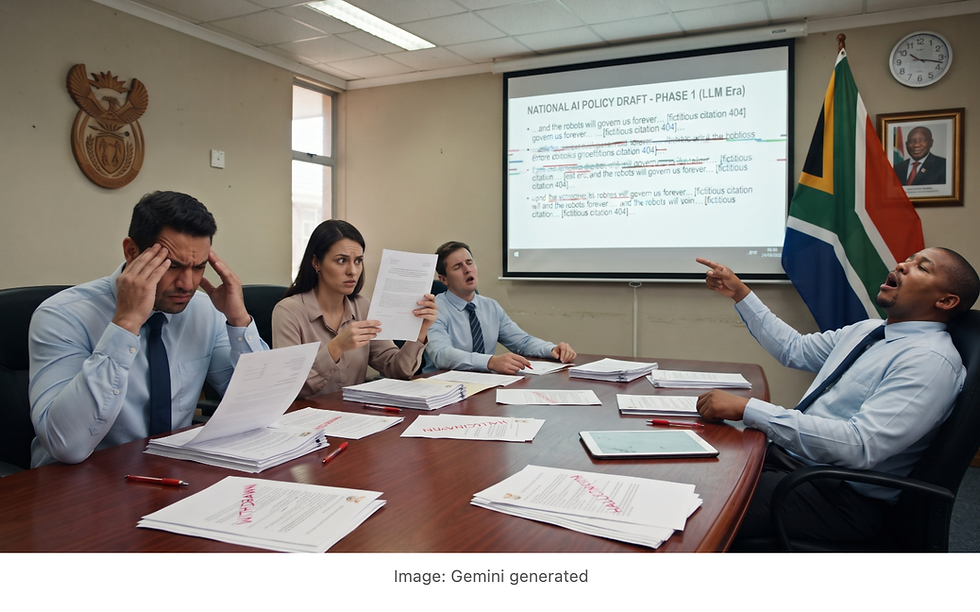
Some of the publications I write for have told me that AI detection tools judged my articles to be fake or fabricated. In each case, every factual claim carried a link to a live source that anyone could open and check. I use AI as a research and drafting tool, and I say so openly. What I do not do is invent facts, and a detector cannot tell the difference. As Dr Tyrone August prepares to take office as South Africa’s new Press Ombud on 1 October, committed to upholding ethical journalism, media accountability and public trust, the question of who decides what is fake has become urgent.
CONTEXT AND BACKGROUND
Our universities have already confronted this question and reached a clear answer. The University of Cape Town switched off its AI detector in October 2025, Stellenbosch University stopped using Turnitin’s AI function at the end of that year, and the University of the Free State followed from 1 July 2026, on the basis that detector results cannot be treated as conclusive evidence of misconduct. Explaining the decision, the Free State’s deputy vice-chancellor said the institution would reaffirm academic judgement rather than rely on technologies whose outcomes remain contested.
The bias is as troubling as the error rate. A Stanford study found that seven leading detectors wrongly flagged 61% of authentic essays by non-native English speakers as machine-generated, and as I told ITWeb, predictable, simple writing is exactly what people produce in a second, third or fourth language. In a multilingual country like ours, that is not a technical footnote.
I have previously written about this. In an article on educational accountability, I argued that detection tools are unreliable and biased against non-native English speakers, and that when an institution acts on a flag, a named person must answer for that decision rather than the machine.
INSIGHT AND ANALYSIS
Publishers face the same problem with higher stakes. A detector does not detect fabrication. It estimates whether text looks statistically like machine output. An article can be written with AI assistance and be entirely accurate, or written by hand and be entirely false. Fabrication is a question of fact, and the test is whether the sources exist and say what the article claims. Checking that takes minutes. No algorithm can do it on an editor’s behalf.
The wider pressure makes this urgent. Government has said the national AI policy will compel platforms to label AI-generated content and will prohibit the broadcasting of fake and misleading news about South Africa. Labelling has merit. A state power to define fake news sits uneasily with press freedom. Neither approach tests whether a claim is true. Meanwhile, few South African newsrooms have clear AI policies, and the Press Council’s guidance on AI remains non-binding.
IMPLICATIONS
Publishers should take five steps. They should stop treating detector scores as evidence, since the universities have already concluded that they are not. They should test for fabrication by checking sources, which is the only test that answers the question. They should publish an AI-use policy that forbids invented quotes, fake sources and unverified claims, rather than forbidding assistance that is disclosed and checked. They should hold the named author accountable for every claim, however the text was produced, and give writers the chance to answer specific concerns before a piece is rejected. Finally, they should invest in verification skills, since most South African journalists report receiving little or no formal training in AI. The arrival of a new Ombud is a natural moment for the industry to agree on these standards together.
CLOSING TAKEAWAY
Truth has never been established by guessing at an author’s method. It is established by checking the claims. Our universities recognised that a probability score cannot carry the weight of an accusation, and they chose human judgement instead. Our publishers should do the same, before they drive away careful writers while deliberate falsehoods, which rarely arrive with footnotes, pass through untested. A detector can only judge style. An editor must judge truth.
Johan Steyn is a prominent AI thought leader, speaker, and author with a deep understanding of artificial intelligence's impact on business and society. He is passionate about ethical AI development and its role in shaping a better future. Find out more about Johan's work at https://www.aiforbusiness.net

Comments