


Educational Accountability Cannot Be Delegated to a Machine

Ahead of my keynote at the Quality Assurance 5.0 Summit in Durban, three questions I want every academic committee in the country to answer.

Follow me on LinkedIn: https://www.linkedin.com/in/johanosteyn/
Next week, I take the stage at the Quality Assurance 5.0 Summit at the Coastlands Skye Hotel in Umhlanga, Durban, alongside vice-chancellors, quality officers, regulators and academic leaders from across Southern Africa. My keynote is on reimagining excellence in AI-enhanced education, but the argument I intend to make is not really about artificial intelligence. It is about who signs the decisions we make with it.
CONTEXT AND BACKGROUND
Students have moved. Institutions have not caught up. The 2026 Student Generative AI Survey from the Higher Education Policy Institute and Kortext, based on responses from over one thousand UK undergraduates, found that ninety-five per cent of students use AI in at least one way and ninety-four per cent use generative AI to help with assessed work, while only thirty-six per cent feel encouraged by their institution to use it.
Comparable South African data does not yet exist at this scale, and that absence is itself part of the problem. If your institution has never measured its position, the honest answer to how many of your students used AI on their last assignment is that you do not know.
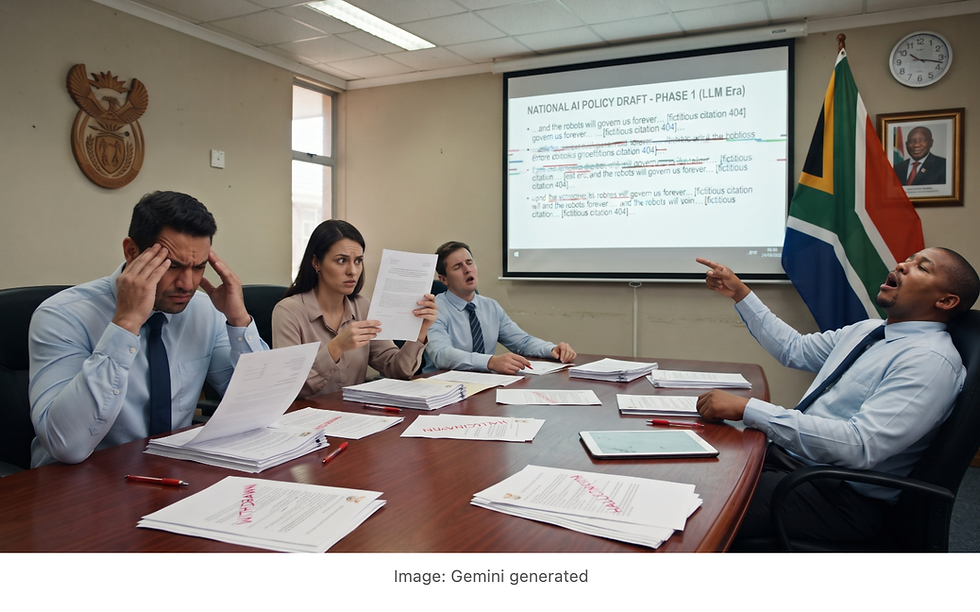
The framing of AI risk as a student behaviour has become dangerous. In April, our own draft National Artificial Intelligence Policy was withdrawn after it emerged that several of the document’s sixty-seven references were fabricated.
The Minister of Communications and Digital Technologies conceded that the most plausible explanation was that AI-generated citations had been included without proper verification, and that vigilant human oversight of AI is critical. No student was involved. The document meant to govern artificial intelligence in South Africa was itself compromised by unverified AI output passing unchecked through departmental review. I served on the working group that fed into the earlier framework, so I do not make this observation lightly.
INSIGHT AND ANALYSIS
The failure of policy is not the failure I want to draw delegates towards in Durban. The failure I want to draw them towards is quieter, and it is structurally identical: the administrative rubber-stamping of unchecked machine output, whether at cabinet level or in a faculty disciplinary hearing. When a detection tool flags a student and an institution acts on that flag, someone has made a decision. In most institutions I visit, nobody can name that person. The tool becomes the alibi.
That would matter less if the tools were reliable, and they are not. Stanford researchers found that across seven widely used detectors, more than sixty-one per cent of essays by non-native English writers were incorrectly flagged as AI-generated, while essays by native speakers were classified substantially more accurately. The University of Waterloo disabled Turnitin’s AI detection functionality in September 2025, citing unreliability, documented bias, and internal tests in which entirely human-written text was flagged as fully AI-generated.
South African universities have started to move. Stellenbosch discontinued Turnitin’s AI text detection at the end of 2025, and Wits, the University of Pretoria and North-West University have all shifted from policing to designed assessment. For an audience in a region where most students are assessed in a second or third language, this is not a technology question. It is a discrimination exposure that belongs in front of a council and a legal office, not a help desk. In South African law, an adverse academic decision resting on an opaque and statistically biased instrument sits uncomfortably close to the terrain of the Promotion of Administrative Justice Act.
I have previously written about this pattern in a piece on how organisations are measuring AI-era productivity while failing to measure whether their people are still learning. The evidence base is only building. The OECD Digital Education Outlook 2026 concludes that when generative AI is used without pedagogical guidance, outsourcing tasks to it enhances performance with no real learning gains. Performance without learning is exactly what a productivity dashboard captures, and a quality assurance judgement should refuse.
IMPLICATIONS
Cognitive governance, the principle I will defend in Durban, holds that in any process where a machine contributes to a judgement, the human must remain a net contributor rather than a rubber stamp, and accountability must sit with a named person who could explain and defend the decision. Delegating the work is legitimate. Delegating the answerability is not. The same principle applies to teaching. If AI-assisted instruction is now happening across a faculty, someone is accountable for whether it is any good. If no name can be produced, the institution does not have a policy. It has a document.
CLOSING TAKEAWAY
None of this requires budget, a vendor or a new framework, which is why I will leave delegates in Umhlanga with three questions to take back to their next academic committee. Who owns the quality of AI-assisted teaching in this institution, by name, with the standing to answer for it. Who answers when an AI-assisted integrity decision is wrong, and has the detection tool the institution licences ever been evaluated against its own student population. Which single workflow is worth designing properly, and who owns it. One designed workflow teaches an institution more about its own readiness than a year of framework drafting. If the sector will not name owners for its AI-assisted judgements, it should not be surprised when the accreditor eventually does it for us.
Johan Steyn is a prominent AI thought leader, speaker, and author with a deep understanding of artificial intelligence’s impact on business and society. He is passionate about ethical AI development and its role in shaping a better future. Find out more about Johan’s work at https://www.aiforbusiness.net


Comments