


Your child’s school already has an AI policy. The learners wrote it.

While governing bodies deliberate, every South African classroom is already running a policy on homework, essays and assessment. It is simply not the school’s.
Sign up for my Substack daily AI newsletter here.
Follow me on LinkedIn: https://www.linkedin.com/in/johanosteyn/
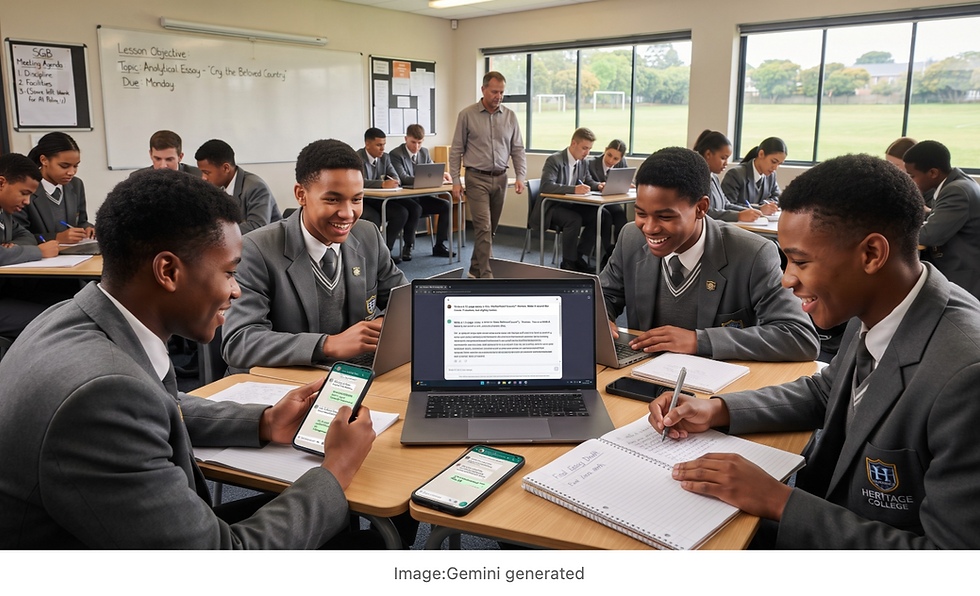
At eleven o’clock on a Sunday evening, in homes across Johannesburg, Cape Town, Polokwane and Mthatha, a sixteen-year-old opens a chat window and types in an English essay topic. The output arrives in seconds, lightly edited, printed and handed in on Monday morning. The teacher reads it and wonders whether the voice in the paragraph is the learner’s. The school governing body met two weeks ago and did not discuss artificial intelligence. The principal has been meaning to raise it, but the term’s calendar had other priorities. The acceptable-use rule in the school, in the practical sense that matters, has already been set. It was set by the learners, between themselves, on Discord and in the WhatsApp group, and nobody at the school has yet asked what it says.
CONTEXT AND BACKGROUND
South African principals are living this problem openly now. A September 2026 Sunday Times report documented principals from Pretoria to Pietermaritzburg wrestling with homework in the AI era and arriving, individually, at different conclusions. A BusinessDay commentary in June posed the specific question the sector has not answered: who at the school decides whether a chatbot-assisted essay is a disciplinary matter, a pedagogical opportunity, or both. The Daily Maverick in July argued that bans in the current form are unenforceable and that the real question is design, not prohibition.
INSIGHT AND ANALYSIS
The vacuum has three consequences, visible in every South African school this term. The first is governance. Section 8 of the Schools Act makes the governing body responsible for the code of conduct. When the body has not addressed AI, the school’s AI policy has defaulted to individual teacher judgement and whatever the learners themselves have agreed. The second is pedagogy. If homework can be produced in seconds, written output has stopped being a reliable measure of learning. Essays that look polished tell the teacher nothing about whether the thinking happened. The third is equity. A LeapAfrica report in June argued the gap between well-resourced and under-resourced South African schools is now widening along a new axis: whether the school has time, funding and staff to redesign assessment, or whether it is quietly resorting to unenforceable bans.
The pedagogical response from universities and secondary schools internationally has converged on one idea. Assessment has to make thinking visible. The University of California Berkeley’s Center for Teaching and Learning recommends assignments built around drafts, oral explanations and recorded reasoning rather than polished final products. Times Higher Education reaches the same conclusion with specific examples of small changes to a brief that reveal whether a learner understands the material or has merely received it. The point for South Africa is that redesigning assessment does not require expensive software; it requires a shift in design that an under-resourced township school and a well-resourced private school can both implement. This is the single highest-leverage change a South African school can make this term. If the learner cannot explain the essay in two minutes, the essay did not measure learning.
IMPLICATIONS
For the school governing body, three agenda items belong on the next meeting. A written acceptable-use position for AI, covering AI-free, AI-assisted and AI-integrated assignments. An assessment redesign brief for every head of department, with a target date before the next assessment cycle. A community meeting with parents, chaired by the principal, in which the school’s position is explained in plain terms, and parents are invited to align home practice. Without the parent side of the policy, the home becomes an unregulated permission zone.
For the principal, the question is simpler. The AI policy the school is operating under this week is one the school did not write. The next SGB meeting is the first chance to replace it with one the school owns, before the term’s assessment cycle makes the problem a legal one.
CLOSING TAKEAWAY
The children have not done anything wrong. They are using the tools that are available to them, within a rule system that nobody has written down for them. The responsibility, under Section 8 of the Schools Act, sits with the governing body. The responsibility, as a question of their cognitive development, sits with every adult at home and at school who cares whether the thinking the child does is still their own. The AI policy already in force at your child’s school is the one the learners wrote. The question for next term is whether the adults are ready to write a better one.
Author Bio
Johan Steyn is a prominent AI thought leader, speaker, and author with a deep understanding of artificial intelligence’s impact on business and society. He is passionate about ethical AI development and its role in shaping a better future. Find out more about Johan’s work at https://www.aiforbusiness.net


Comments