


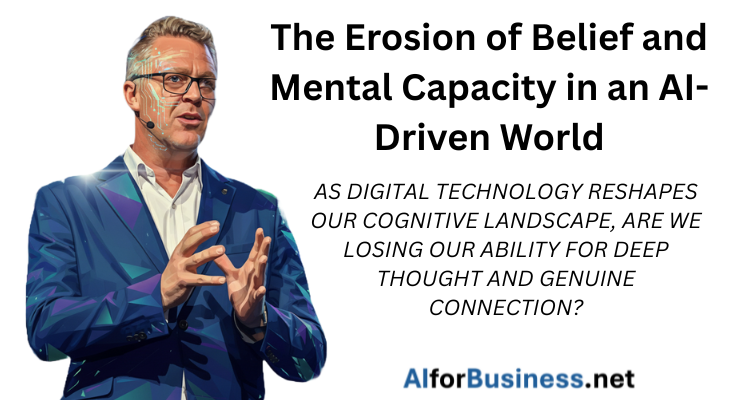
The Erosion of Belief and Mental Capacity in an AI-Driven World

As digital technology reshapes our cognitive landscape, are we losing our ability for deep thought and genuine connection?
Audio summary: https://youtu.be/W7n8wDPk_Q8
As someone deeply immersed in Artificial Intelligence and technology, I often write about various issues of interest to me that I want to bring to the reader’s attention. While my main work is in Artificial Intelligence and technology, I also cover areas around politics, education, and the future of our children. This article delves into a profound concern: the potential erosion of our mental capacities and the very foundations of belief in an increasingly digitised and automated world, a topic that resonates deeply with the future of our children and the fabric of our society.
The relentless march of digital technology, particularly the rise of artificial intelligence, has undeniably brought unprecedented convenience and access to information. Yet, it also compels a crucial introspection: have we, in our embrace of digital tools, inadvertently sacrificed our innate mental capacity for deep thought, sustained attention, and the cultivation of meaningful relationships? This question gains particular poignancy in a world where traditional beliefs and societal structures often seem to waver, leaving us to ponder the true cost of our technological advancements.
CONTEXT AND BACKGROUND
Nicholas Carr’s seminal 2008 essay, “Is Google Making Us Stupid?” articulated a growing unease about the internet’s impact on our cognitive processes. Carr argued that the internet’s emphasis on rapid information retrieval and fragmented content consumption was rewiring our brains, making us adept at skimming but less capable of deep, contemplative reading and thought. This concern has only intensified with the advent of advanced AI and automation.
Evolutionary biologist Robert Brooks, as quoted in the Daily Maverick, even suggests that ubiquitous AI could lead to subtle, long-term evolutionary changes in humans, potentially resulting in smaller brains and fewer deep friendships. The Massachusetts Comprehensive Assessment System (MCAS) report from 2013, while not directly addressing AI, highlights the critical importance of foundational cognitive skills in an educational context, implicitly underscoring the potential risks if digital reliance undermines these very capacities.
INSIGHT AND ANALYSIS
The core concern is whether our reliance on digital technology, particularly AI, is leading to a genuine loss of mental capacity. When AI tools perform complex cognitive tasks—from summarising texts to generating creative content—do our own brains become less adept at these functions? Research suggests that while digital technology can enhance certain cognitive abilities, such as multitasking, it may simultaneously diminish others, like sustained attention and critical analysis.
The constant stream of notifications and the instant gratification offered by digital platforms can shorten our attention spans, making it challenging to engage with complex ideas that require prolonged focus. This is personally important to me because I have observed these shifts in myself and others. The ability to engage in deep, reflective thought is fundamental to human flourishing, and its erosion poses a significant threat to our intellectual autonomy. For our country, a populace with diminished critical thinking skills and fractured attention spans is less equipped to address complex societal challenges, make informed decisions, or foster robust democratic discourse.
For our children, who are growing up as “digital natives,” this is even more critical. Their developing brains are highly susceptible to environmental influences, and a childhood dominated by superficial digital interactions could profoundly impact their long-term cognitive and emotional development. We must actively cultivate environments that encourage deep reading, critical inquiry, and genuine human connection to counteract these potential negative impacts.
IMPLICATIONSThe implications extend beyond individual cognitive function to the very fabric of society. If our collective mental capacity for deep engagement wanes, so too might our ability to grapple with complex ethical dilemmas, foster innovation that truly serves humanity, and maintain the nuanced social bonds that underpin healthy communities. Policymakers and educators face the urgent task of designing systems that leverage AI’s benefits without compromising essential human capabilities.
This involves promoting digital literacy that includes critical evaluation of information, encouraging offline activities that foster concentration and creativity, and developing educational curricula that prioritise deep learning over superficial knowledge acquisition. The future of our children hinges on our ability to strike this delicate balance, ensuring they inherit a world where technology empowers, rather than diminishes, their human potential.
CLOSING TAKEAWAY
In an age where AI increasingly performs cognitive heavy lifting, we must consciously safeguard our mental capacity for deep thought and genuine connection. Our future, and that of our children, depends on our ability to navigate this digital landscape with intentionality, ensuring technology serves our deepest human values.
Author Bio: Johan Steyn is a prominent AI ethicist, author, and international speaker. His work focuses on the practical application of AI in business and its broader societal impact. He advises organisations on AI strategy and responsible technology adoption, sharing his insights globally. Learn more about his work at https://www.aiforbusiness.net


Comments