


Nobody in This Hiring Process Is Human Any More

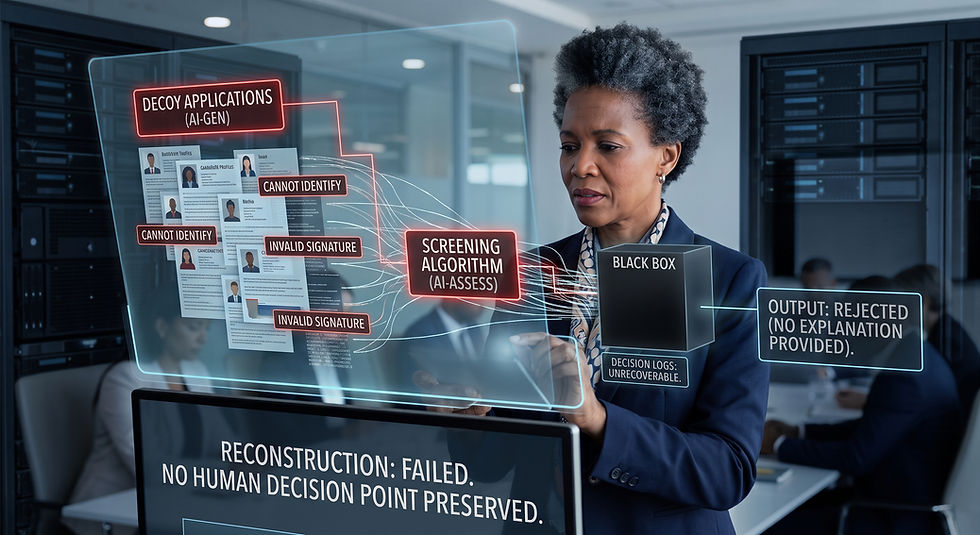
Candidates write applications with AI and employers screen them with AI, yet every legal obligation still rests on a person.
Sign up for my Substack daily AI newsletter here.
See my AI Training course portfolio for corporate Business Leaders here.
Follow me on LinkedIn: https://www.linkedin.com/in/johanosteyn/
The team at Google DeepMind responsible for mitigating the risks of advanced artificial intelligence would prefer that you did not rely on Google’s hiring technology. Its AGI Safety and Alignment Team has been circulating a separate form to candidates for its open roles, so that a person rather than a filter sees the application. That is a remarkable admission from inside the company selling these tools to everyone else.
CONTEXT AND BACKGROUND
The document, marked for limited circulation, told applicants there was a “non-trivial probability your CV will be screened out incorrectly.” A Google DeepMind spokesperson denied that the company’s systems filter applicants incorrectly, describing the form as a route past recruiter review rather than a shortcut to being hired. The same reporting notes that Google markets its own workplace products to businesses as a way to evaluate résumés and save human resources teams time. The form carried a second instruction that is just as telling. Candidates were advised that their applications would be stronger without machine assistance, because the people reading them had grown weary of answers that all sound alike. Both sides of the transaction have automated, and neither trusts the other’s automation.
INSIGHT AND ANALYSIS
The interesting problem is not accuracy. It is proof. Section 71 of the Protection of Personal Information Act restricts decisions taken solely on automated processing where those decisions carry legal consequences or affect a person substantially, and it names performance at work explicitly among the profiling categories covered. Where the exception for contractual decisions applies, the employer must give the affected person an opportunity to make representations and must supply enough information about the underlying logic for those representations to be meaningful. Bowmans is direct about what that requires in practice, noting that the responsible party must therefore understand how the system reached its result, which the black box problem makes difficult. An employer who cannot reconstruct a rejection cannot comply with the section, whatever the quality of the underlying model.
I have previously written about this in a piece asking who is really speaking when artificial intelligence finishes your sentences, which examined what happens to authorship and accountability when the machine shapes the words. Hiring is that question with a legal consequence attached.
IMPLICATIONS
Other jurisdictions have already decided that the record matters more than the intention. California’s regulations on automated decision systems, effective from October 2025, require employers to retain automated decision documentation for at least four years, extend liability to agents acting on the employer’s behalf, and treat the presence or absence of bias testing as relevant evidence in a discrimination claim. Whether that evidence can be obtained is a separate matter. On 28 May 2026 a California federal judge held that a vendor’s bias-testing data, although relevant and probative of disparate impact, was shielded from disclosure by attorney-client privilege because its lawyers had curated the underlying data and the testing existed to produce legal advice. Notably, the vendor did not claim privilege over testing carried out by an outside consultant. The testing a buyer can actually see is the testing nobody structured to be invisible.
Employers with European exposure carry a further obligation, since the transparency requirements under Article 50 of the European Union’s artificial intelligence legislation took effect on 2 August 2026 and the Commission has confirmed it will enforce them.
CLOSING TAKEAWAY
The controls are not complicated, which makes their absence harder to defend. Maintain an inventory of every tool that scores, ranks or screens candidates. Test for adverse impact before deployment and periodically afterwards, and record the results. Contract for transparency on training data, access to logs and notice of material model changes. Give candidates a route to challenge an automated assessment, and make certain a person with authority to overturn the output actually exercises it. The board question is not whether the technology works. It is whether anyone in the organisation could explain, under oath and eighteen months later, why a particular person was rejected. When neither the application nor the assessment involved a human being, the answer usually arrives too late to help.
Johan Steyn is a prominent AI thought leader, speaker, and author with a deep understanding of artificial intelligence’s impact on business and society. He is passionate about ethical AI development and its role in shaping a better future. Find out more about Johan’s work at https://www.aiforbusiness.net


Comments