


Huawei Published The Numbers Nobody Else Has Compiled

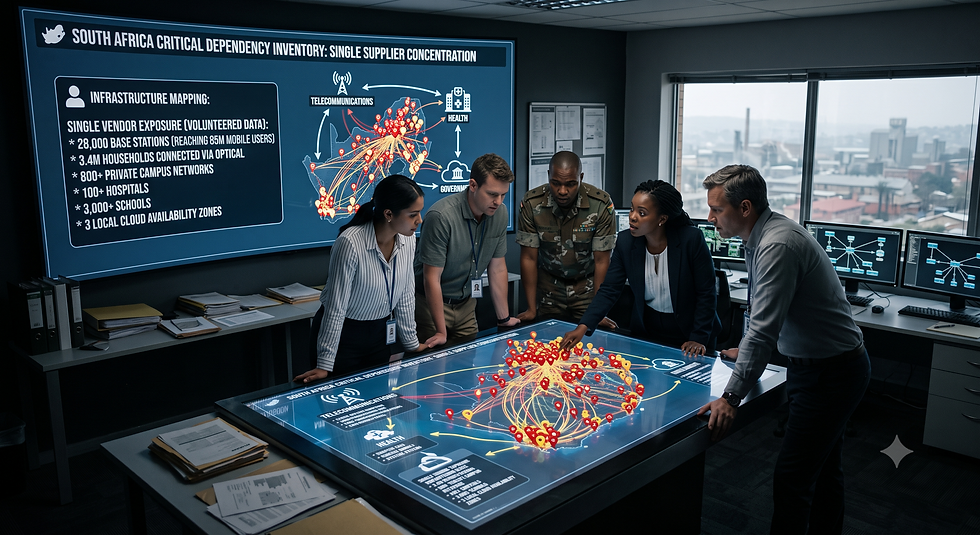
Base stations, hospitals, schools, campus networks and three cloud zones, all disclosed voluntarily at a conference, and no South African institution holds the consolidated picture.
Sign up for my Substack daily AI newsletter here.
See my AI Training course portfolio for corporate Business Leaders here.
Follow me on LinkedIn: https://www.linkedin.com/in/johanosteyn/
The most useful South African technology document of the past month was not written by a regulator or a research council. It was a supplier presentation, delivered from a stage in July, and it contains an inventory of national infrastructure dependence that no state body has assembled and no board has requested. This is a governance question before it is a geopolitical one, and the two have been allowed to collapse into each other.
CONTEXT AND BACKGROUND
At Huawei’s South Africa Connect 2026, attended by 2,900 government and industry leaders, the company set out its local footprint in unusual detail. Its network reaches 85 million mobile connections globally, described by the company as mobile users, through 28,000 base stations. Its optical solutions connect 3.4 million households to broadband. It has deployed more than 800 private campus networks, extending connectivity to over 100 hospitals and more than 3,000 schools.
Huawei Cloud operates from three availability zones in South Africa, serving upwards of 300 customers and over 1,000 technology partners. Its local partner ecosystem numbers more than 1,400 South African companies accounting for 94.7 percent of local revenue, with named work including a digital twin project with BCX, smart retail with Altron, connected healthcare with Gijima and secure paperless government with CoCre8. Deputy general manager Kui Zheng projected that AI could contribute between R1 trillion and R1.4 trillion to the economy and create 400,000 jobs by 2030.
INSIGHT AND ANALYSIS
Take the forecast out of it, since a projection produced by a company selling the infrastructure required to reach it is not evidence of anything. What remains is the inventory, and the inventory is the story. Huawei was not making a disclosure. It was listing achievements, which is what a supplier does at its own conference. That the most complete public map of South African infrastructure dependence exists because a vendor was proud of it, rather than because a regulator or a risk committee asked, is the part worth sitting with. Every large South African organisation maintains a risk register recording currency exposure, sovereign risk and counterparty concentration.
Almost none record infrastructure supplier concentration, despite applying that discipline routinely to logistics, banking and insurance. The pattern is regional rather than local. Huawei has built around 70 percent of Africa’s 4G networks, a position enabled by Chinese policy banks providing strategic credit lines that allowed equipment, services and financing at prices Western competitors could not match, and governments across the continent now rely heavily on a small number of firms for hardware maintenance, modernisation and training. The honest part of that analysis is what follows it. Western developers face higher credit costs because Africa is perceived as inherently risky, and American alternatives to Chinese firms are few and far between. This dependence was not chosen. It accumulated, one commercially rational decision at a time, because the alternative did not show up.
IMPLICATIONS
The AI layer changes what concentration means. Development analysts have warned that control over the critical infrastructure, data and energy powering African AI models could translate into influence over politics and public life, and that a sector dominated by a single foreign power would reduce its own competitiveness, with the recommended response being local capability building and deliberate diversification of collaborations rather than exclusion.
That is the right framing, and it starts with an audit nobody has run. Which South African institutions depend on one supplier for network, cloud and application layers simultaneously? What is the switching cost, in rand and in years? Where does the data sit, under whose jurisdiction, and who holds the keys? Which of these arrangements would survive a change in export controls, sanctions or trade policy that South Africa neither caused nor controls? These are procurement and governance questions, answerable with documents an organisation already possesses.
CLOSING TAKEAWAY
None of this is an argument for exclusion. Huawei has operated here for 28 years, employs South Africans, delivers through South African partners, and built infrastructure that others declined to build at prices this country could afford. Much of the international pressure to exclude Chinese equipment has served commercial interests as well as security ones, and South Africa is entitled to a foreign policy of its own. The argument is narrower, and it precedes all of that. A country that cannot describe its own single-supplier exposure is not in a position to decide anything about it, including deciding that the exposure is acceptable. The numbers were published in July by the company itself. The compilation is the part we have not done.
Johan Steyn is a prominent AI thought leader, speaker, and author with a deep understanding of artificial intelligence’s impact on business and society. He is passionate about ethical AI development and its role in shaping a better future. Find out more about Johan’s work at https://www.aiforbusiness.net



Comments