


Claude Opus 5 Is Not The Story. The Price Of Intelligence Falling Is
- Johan Steyn

- Jul 30
- 3 min read
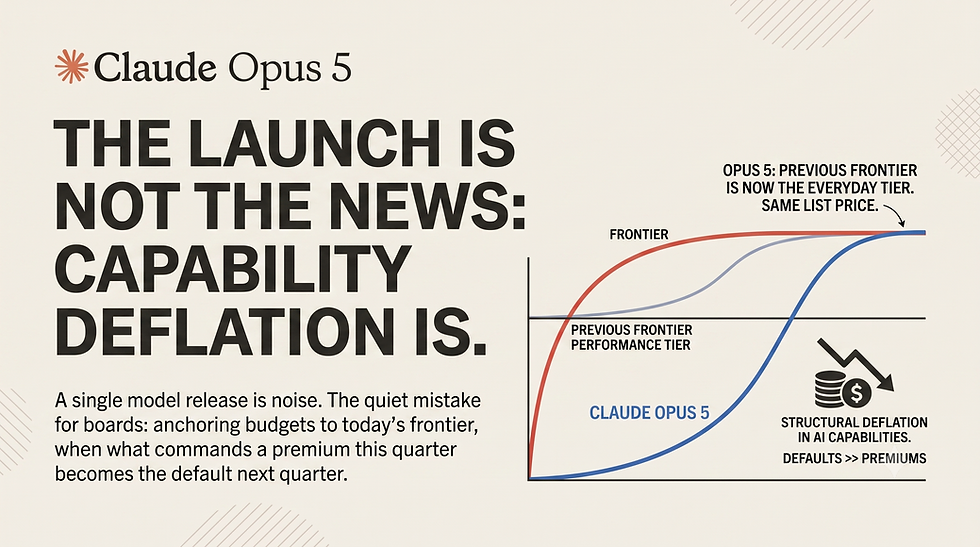
A single release changes little, but the speed at which frontier capability becomes the cheap default should reshape how boards plan.
Sign up for my Substack daily AI newsletter here.
See my AI Training course portfolio for corporate Business Leaders here.
Follow me on LinkedIn: https://www.linkedin.com/in/johanosteyn/
A new artificial intelligence model was released this month, and for most business leaders, that is not news. Releases now arrive on a cadence of weeks, and no board should be revising its strategy because one vendor shipped a point upgrade. The more useful question is what a launch like Claude Opus 5 reveals about the direction of the market, because the signal underneath it matters far more than the product itself. What it reveals is that the price of intelligence is falling fast, and that has consequences a board can actually plan around.
CONTEXT AND BACKGROUND
Consider the timeline. Six weeks ago Anthropic’s Fable 5 was described as its most capable publicly available model, priced at the top of its range at ten dollars per million input tokens and fifty per million output. This month the company released Opus 5, positioned as near-frontier intelligence at roughly half the cost and built for everyday use rather than showcase tasks. A capability that sat at the frontier weeks ago is now the cheaper, ordinary tier. This is not a story about one model beating another. It is a story about how quickly the premium of one quarter becomes the default of the next, and how little time a business now has to treat any single model as a durable advantage.
INSIGHT AND ANALYSIS
Independent testing makes the pattern concrete. Artificial Analysis, which benchmarks models rather than selling them, ranked Opus 5 at the top of its intelligence index and its agentic knowledge-work benchmark, ahead of the pricier Fable 5, while costing around a fifth less per task and holding the same headline price as its predecessor. More capability at no increase in price is the opposite of how leaders are used to planning technology spend.
The deeper lesson, though, is that a better model changes very little for most organisations. PwC’s 2026 study of more than twelve hundred executives found that roughly three quarters of AI’s economic value is captured by only a fifth of companies, and that these leaders are not the ones deploying more tools but the ones redesigning how work is done and pointing AI at growth rather than mere efficiency. Separate research from the Massachusetts Institute of Technology found that around ninety-five per cent of enterprise AI efforts delivered no measurable profit impact at all. The binding constraint is organisational, not the model.
IMPLICATIONS
For boards, two consequences follow. The first is that anchoring budgets, multi-year vendor commitments or competitive assumptions to today’s frontier is a quiet mistake, because the capability you pay a premium for now will be cheap and ordinary within months. The disciplined posture is shorter commitments, model-agnostic systems, and the freedom to move as prices fall. The second is that access to the best model has stopped being an advantage worth chasing, because competitors can rent the same capability on the same terms the same week. For South African leaders this cuts both ways. Cheaper capable models genuinely lower the barrier and improve what a firm can do within a constrained, rand-denominated budget, which is welcome. The catch is that every competitor gets the identical lift, so the difference will be made not by which model a company can afford, but by how well it redesigns its work to use any of them.
CLOSING TAKEAWAY
The temptation with each release is to ask whether to upgrade. The better question is what the pattern of releases is telling you, and the answer is consistent: intelligence is becoming abundant and cheap, while the scarce resource is the organisational capacity to turn it into value. A leader who reads the Opus 5 launch as a reason to buy has read it backwards. The correct response is almost the opposite of the excitement around it, which is to stop chasing models altogether and to build the data, the workflows and the leadership that let a business benefit from whichever model happens to be best and cheapest next quarter. The launch is not the story. The falling price of intelligence, and what you are able to do with it, is.
Johan Steyn is a prominent AI thought leader, speaker, and author with a deep understanding of artificial intelligence’s impact on business and society. He is passionate about ethical AI development and its role in shaping a better future. Find out more about Johan’s work at https://www.aiforbusiness.net



Comments